

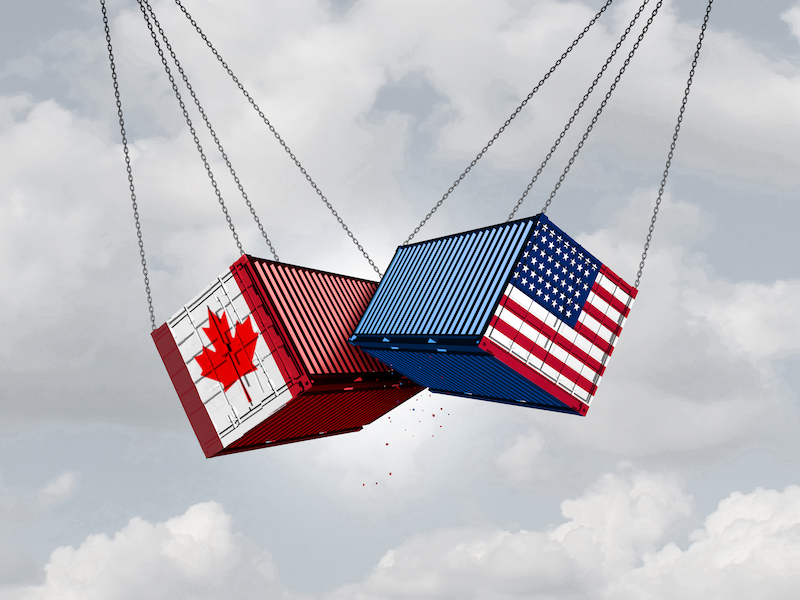
Welcome to Soundbites, weekly insights on market trends and investment strategies, brought to you by Investment Executive and powered by Canada Life. For today’s Soundbites, we’re talking tariffs with Corrado Tiralongo, CIO and vice-president of asset allocation with Canada Life Investment Management. We talked about the most vulnerable sectors, and we started by asking how likely he thinks it is that we’ll see the imposition of new U.S. tariffs.
Corrado Tiralongo (CT): My view is that tariffs are coming. What’s unclear is how much the tariffs will be, whether they’re going to be 10% universal tariff, or they’re going to be 25% on select goods. The timing is unclear. The amount is unclear. The goods and or services that will be subject to tariffs are unclear. But my opinion is that a 10% universal tariff is the likely outcome, which would impact Canadian exports but not likely cause a recession. The Canadian dollar has depreciated about 6% to 7% since the first talk of a universal tariff came about. That makes Canadian goods more competitive in the marketplace, so partly offsetting that 10% tariff. A 25% tariff would be a significant event to the Canadian economy. We estimate that’s going to reduce GDP by 3%, driving Canada and Mexico into a recession.
What’s driving the Trump administration to impose tariffs?
CT: The new American administration is looking at tariffs as a means to bolster national wealth and prosperity, to extract concessions from trading partners, to address national security concerns, and there is also this undertone of an isolationist, America-First policy, extracting the most that they can from previously aligned and cooperative trading partners. It’s clear that Trump incorrectly views America’s trade balance as a barometer for national wealth and prosperity, which it’s not. It’s going to be very chaotic over the next four years because of this isolationist view.
The current trade balance between Canada and the U.S.
CT: Currently, there is a US$45-billion annual trade deficit with Canada, which really works out to 0.2% of U.S. GDP. If we removed energy exports from the equation, the whole trade story flips. Canada would have a US$45 billion trade deficit with the U.S. So this talk about trade deficits and subsidization of Canadian companies is a false narrative. As we saw in you know, Trump’s last term in office, the rhetoric doesn’t often match the facts.
Most vulnerable sectors
CT: Energy, automotive and agriculture are the most vulnerable sectors. The energy sector faces challenges despite the U.S. dependence on Canadian oil. Tariffs could create short-term volatility. Automotive manufacturing is heavily reliant on cross-border supply chains. And tariffs would increase production costs and reduce demand. And frankly, I think, would create chaos for automotive manufacturers. In agriculture, retaliatory tariffs or reduced access to U.S. markets could really dampen demand for Canadian exports, particularly in sensitive areas like dairy.
Risk-mitigation strategies
CT: Mitigation strategy, I think, is longer term. The way to mitigate the threat of U.S. tariffs is to reduce reliance on U.S. trade and enhance trading relationships through agreements that we have today, like the Comprehensive and Progressive Agreement for Trans-Pacific Partnership and the Canada European Union Comprehensive Economic and Trade Agreement, strengthening ties with emerging markets like India and Southeast Asia. Any effect that we could have in diversifying our trade relationship is really critical.
And finally, what’s the takeaway in this contentious moment in history?
CT: One of the things that I think for sure, is over the next four years, Canada and the U.S. are not going to be trading any friendship bracelets. The rhetoric right now is in isolationist policy and antagonistic policy, and so it risks fracturing relationships. Any way you cut it, we’re highly economically tied to the U.S. That’s not going to change. But it is going to be a difficult time. We foresee that global economic growth is still going to be positive, but it’s not a time to take significant bets across client portfolios.
Well, those are today’s Soundbites, brought to you by Investment Executive and powered by Canada Life. Our thanks again to Corrado Tiralongo of Canada Life Investment Management. Visit us at investmentexecutive.com, where you can sign up for our a.m. newsletter and never miss another Soundbite. Thanks for listening.
**
Go back to the article.