
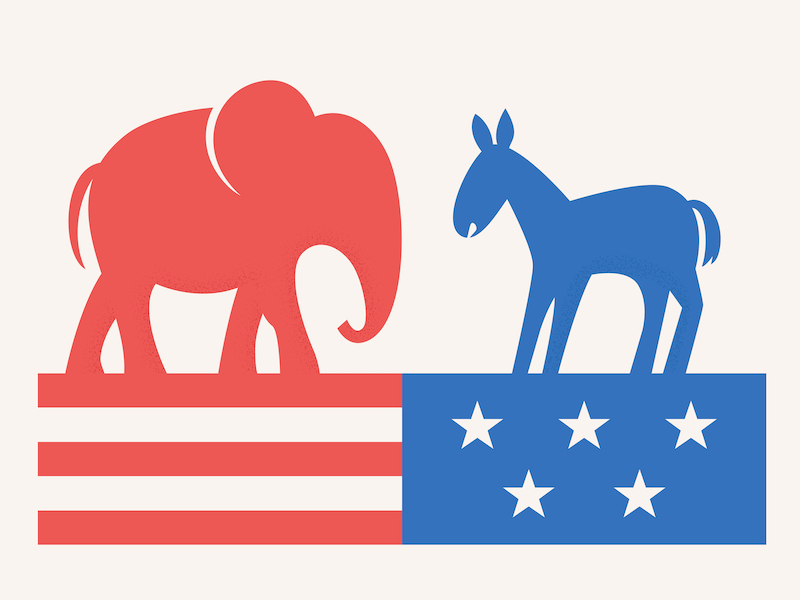
Welcome to Soundbites, weekly insights on market trends and investment strategies, brought to you by Investment Executive and powered by Canada Life. For today’s Soundbites, we’re talking with Jack Manley, global market strategist with J.P. Morgan Asset Management about what the U.S. election could mean for markets. We talked about debt and deficit implications, foreign policy and we started by asking how markets have historically responded in U.S. election years.
Jack Manley (JM): Markets do not like uncertainty. And elections are always going to be profound sources of uncertainty, and so, as a result, they are typically profound sources of volatility. And I would say that this election cycle has actually been unusually volatile. Now, I do think you will have a period of calm post election. That is pretty typical because markets then know what the composition of government is going to look like. And if you know what the composition of government looks like, then you can get a sense of what policies may be coming down the pipeline, and you can plan for or around those potential policy changes. So, a calm regardless of who wins is sort of the base case coming out of this election.
Implications for the debt and deficit.
JM: It doesn’t matter what side of the aisle you’re on in U.S. politics, both sides like to spend money that we don’t have. The end result is the same, which is that deficits widen out and the debt increases. And in fact, the Congressional Budget Office shows that over the next 10 years, barring any sort of policy change, the federal net debt to GDP ratio will increase from about 1 to around 1.25, which is about as high as it’s been since the Civil War, if not the American Revolution. The unfortunate reality here is that the easiest, most politically viable place to trim that proverbial fat is the money that has historically been earmarked for investing in things like bridges, roads, tunnels, hospitals, housing, schools. It is the money that has gone towards enhancing productivity and efficiency. And we need that now more than ever. That’s what I think markets need to be paying attention to.
On tariffs
JM: One of the things that both sides of the aisle seem to agree on is that the United States needs to continue to be tough on China. And the way that we reflect that toughness is through barriers to trade. And Donald Trump, during his administration, launched a quote-unquote trade war with China and levied baseline tariffs on a series of Chinese imports. Those have more or less stood unchallenged under the Biden administration, and would likely stay unchallenged during a potential Harris administration. Being tough on China is the baseline. However, if Donald Trump were to get re-elected in November, we would anticipate that those tariffs would increase on China, and there is even the potential for a new baseline tariff to be levied on all of the United States’ trading partners. This actually is something that the President has unilateral authority to do. And so baseline toughness will stay the same no matter who’s in charge, but things will get tougher under a Trump administration.
Foreign policy
JM: When I think about foreign policy implications as a result of this election, we know that U.S. membership in NATO has been front and center. We know that the Democrats — President Biden, Kamala Harris — are interested in maintaining that relationship and strengthening it. We know that under a potential Trump administration, the attitude towards NATO might change. But we have to remember that U.S. membership in NATO is enshrined through an act of Congress, and the U.S. cannot withdraw from NATO without another act of Congress. The President has no unilateral authority to remove the United States from this treaty organization. What the president can do is decide how intensely they want to enforce some of these mechanisms, right? Do they want to be somewhat passive or active in their membership in NATO? And that’s where I think you would see a difference between a Harris administration and a Trump administration. But membership in NATO and some of the requirements that come with it likely would be unaltered, no matter who ends up in charge come November.
And finally, what’s the bottom line for investors as they anticipate a new U.S. president in 2025?
JM: The bottom line for investors is that over the long run, the U.S. economy will grow, and the U.S. stock market will rise, regardless of what happens in November. But while there’s plenty of evidence to support those stats, it can oftentimes feel unsatisfying to say that. A lot of people will wonder how can policies not have an impact on markets? But we have to remember, policy does have an impact. It just does not exist in a vacuum. There are a lot of other things going on around the world that will influence the direction of markets, outside of the outcome of November’s elections. So, you cannot let your views on politics interfere with your investing decisions.
Well, those are today’s Soundbites, brought to you by Investment Executive and powered by Canada Life. Our thanks again to Jack Manley of J.P. Morgan Asset Management. Visit us at investmentexecutive.com, where you can sign up for our a.m. newsletter and never miss another Soundbite. Thanks for listening.
**
Go back to the article.